


River, lakes and waterways gain attention

Staff Reporters
21 January 2026, 7:46 PM
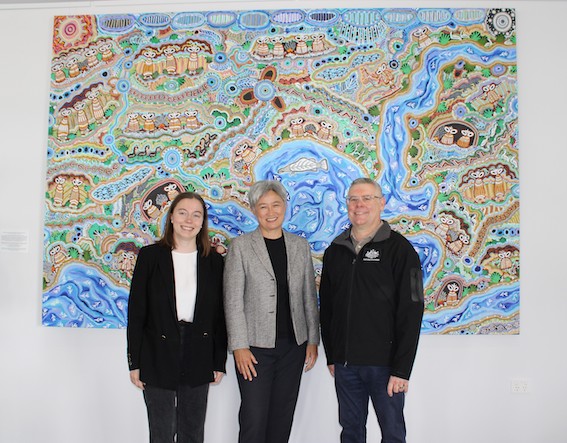 Senator Charlotte Walker with Ministers Penny Wong and Murray Watt at CLLMM.
Listing the Lower Murray River as critically endangered under national environmental law last week, Minister for the Environment and Water Murray Watt, drew national attention to local conditions many are already only too aware of.
The Coorong, Lower Lakes and Murray Mouth Research Centre (CLLMMRC) was a fitting location for this recent announcement, according to Engagement Coordinator Sue Ellison, as its Science Program’s research examines specific areas identified by the Minister.
She says that while much recent local concern has quite rightly been about the marine environment and the coastal algal bloom, the organisation’s work focuses on the lower lakes, Murray Mouth and the Coorong.
“We collaborate with universities, community organisations, governments, peak bodies, and First Nations peoples, described by the Minister as ‘a really good model for the rest of the country as well.’
“Some threats he identified ‘…over-extraction of water, feral animals, habitat loss, weeds, and salinity … made worse by increasingly severe droughts and floods caused by climate change…’ are examined in CLLMM projects, which we hope to continue and expand with further funding to develop our work beyond 2026.
“Since CLLMMRC beginnings in Goolwa in 2023, we now have more than 150 researchers working on twenty-nine priority areas identified through community consultation, developing an information base for informed decision making.”
Research Centre projects include examining the impacts of climate change on the wetlands, lakes, river, and beaches and how this is affecting people, iconic native and migratory species, native vegetation and freshwater sources, revegetation post-Millennial drought and threats to ocean beaches.
“Some of our researchers are in the field, examining habitats for lokeri (local mussels) rakali (local aquatic rodent), rupia (sea grasses), talking to different users of our beaches, or using predictive modelling to help managing agencies identify and prepare for threats,” Ms Ellison says.
CLLMM likes to explore different ways to share its work and next up is Science Speed Dating. Sign up for a night of lively conversation with some of the researchers on Friday 6 February from 6pm to 8.30pm.
Play in the ‘sand box’ – an immersive tool to examine environmental water provision scenarios and explore future climate conditions to support both short- and long-term planning.
Share your views about how to manage the different uses and users of ocean beaches.